


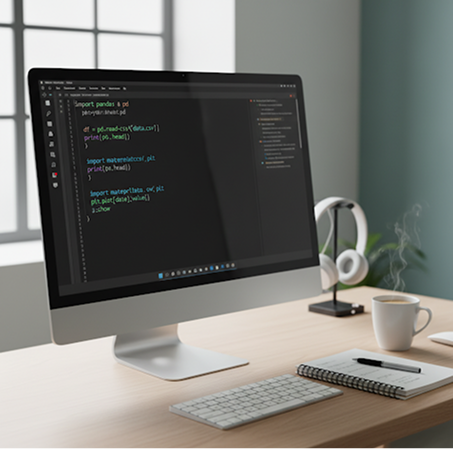
This is the introductory course for Python for Beginners. Please start here if you have no experience coding in Python. This course is self-paced; you can proceed through the course, but need to complete each unit before moving on to the next unit.
- Teacher: Hisham Darwish
- Teacher: Hussein Darwish
- Teacher: Tarek Elkhayyat
- Teacher: Meirc Teacher
- Teacher: Bassam user
- Teacher: هشام ضيا

Master the skills to become a modern product manager by leveraging the power of artificial intelligence. This course teaches you how to integrate AI into every stage of the product lifecycle—from customer discovery and market research to product strategy, roadmap planning, prioritisation, prototyping, analytics, and stakeholder communication.
Through hands-on exercises and real-world case studies, you'll learn how to use AI tools to accelerate decision-making, automate repetitive tasks, generate product documentation, analyse user feedback, create compelling product requirements, and build data-driven product strategies. You'll also explore prompt engineering techniques, AI-assisted product design, and best practices for using generative AI responsibly in product management.
By the end of the course, you'll be able to:
- Use AI to streamline product discovery and validation.
- Generate user stories, PRDs, and product roadmaps with AI assistance.
- Analyse customer feedback and market trends using AI tools.
- Improve collaboration with engineering, design, and business teams.
- Make faster, more informed product decisions through AI-powered insights.
- Understand the ethical considerations and limitations of AI in product management.
Whether you're an aspiring product manager, an experienced PM looking to boost productivity, a founder building digital products, or a business professional transitioning into product management, this course will equip you with practical AI skills that can be applied immediately in today's fast-evolving product landscape.
- Teacher: Bassam user
- Teacher: Belal Userr

Explore the fundamental principles that govern the natural world through the study of matter, energy, motion, and forces. This course provides a strong foundation in classical and modern physics, combining theoretical concepts with practical applications to develop scientific reasoning, analytical thinking, and problem-solving skills.
Students will investigate key topics including mechanics, waves, electricity and magnetism, thermodynamics, optics, and introductory modern physics. Through experiments, simulations, and real-world case studies, learners will gain hands-on experience in applying physical laws to explain natural phenomena and solve engineering and scientific challenges.
By the end of the course, you'll be able to:
- Understand the fundamental laws and principles of physics.
- Analyse motion, forces, energy, and momentum using mathematical models.
- Explain the behaviour of waves, light, electricity, and magnetism.
- Apply physics concepts to solve real-world scientific and engineering problems.
- Conduct experiments, interpret data, and communicate scientific findings effectively.
- Develop critical thinking, quantitative reasoning, and analytical problem-solving skills.
- Understand the role of physics in advancing technology, innovation, and sustainable development.
- Build a solid foundation for further studies in science, engineering, and related disciplines.
Whether you're a secondary school student, university learner, aspiring engineer, scientist, or simply curious about how the universe works, this course will equip you with the knowledge and practical skills needed to understand and apply the principles of physics in both academic and professional settings.
- Teacher: Hisham Darwish
- Teacher: Tarek Elkhayyat
- Teacher: Bassam user
- Teacher: Belal Userr
- Teacher: هشام ضيا


English is a crucial subject that helps students refine their language skills, engage with complex texts, and express themselves more effectively. At this level, students explore a wide range of literary genres including novels, plays, poetry, and short stories, deepening their understanding of literary analysis and criticism. The curriculum often emphasizes critical thinking, persuasive writing, and research skills, preparing students for college-level coursework and professional communication. Additionally, Grade 12 English encourages students to examine diverse perspectives through literature, fostering a broader understanding of human experiences and cultural contexts. This course is essential for developing proficiency in reading, writing, speaking, and listening, equipping students with the tools needed for academic and career success.
- Teacher: Hussein Darwish
- Teacher: Istituto Maragoni
- Teacher: Meirc Teacher
- Teacher: Niti Teacher
- Teacher: Niti2 Teacher
- Teacher: Belal Userr
- Teacher: هشام ضيا

Biology is the scientific study of life and living organisms. It covers a wide range of topics, from the smallest molecules in cells to the complex interactions within ecosystems.
- Teacher: Hussein Darwish
- Teacher: Bassam user
- Teacher: Belal Userr
- Teacher: هشام ضيا